

Before you quit drinking, understand how data shapes modern health advice. Is a new temperance movement ignoring the benefits of moderate wine consumption?
There’s a new temperance movement looming. Have you noticed? If it’s not the U.S. Surgeon General telling us that any alcohol consumption is unsafe[1], it’s the World Health Federation recommending abstinence[2]. And if it’s not peer pressure during Dry January, it’s the increasing offer of dealcoholized wine. Doctors and marketing campaigns and even your friends are all conspiring to get you to quit drinking.
But… does it make sense? Here are my two cents.
A New Temperance Movement Dressed as Medical Advice
Let’s get this out of the way: Heavy drinking is objectively bad for your health. I don’t want to sound like I’m advocating alcoholism or irresponsible alcohol consumption. If you’re driving or under the legal drinking age in your country, don’t drink. If you have problems setting your limits or get violent and abusive when drunk, don’t drink. If you already have health issues that could be made worse by imbibing[3], don’t drink.
So, now let’s talk about medical studies and what they really say about drinking. Part of the alarm connecting alcohol with heart disease was raised when studies in the U.K. found that, and I quote, “even low-risk drinking was associated with higher mortality among older adults with health-related or socioeconomic risk factors.” The study concluded by identifying “inequalities in the detrimental health outcomes associated with alcohol that should be addressed to reduce the high disease burden of alcohol use.”
Sounds severe, right? And it would be if I didn’t purposely leave out two factors from the report. First, the study aims to link alcohol mortality with consumption patterns among older drinkers. Not any drinkers. Not most drinkers, but only older drinkers,
The other factor I omitted was another finding in this study: “Wine preference and drinking only with meals were associated with attenuating the excess mortality associated with alcohol consumption.”
You read that right. Older heavy drinkers face higher mortality risks (duh) and drinking a glass of wine with your meal might be beneficial. So, why did I skip those two facts when I originally mentioned the study? Because the U.S. Surgeon General did as well. Remember: any alcohol consumption is unsafe.
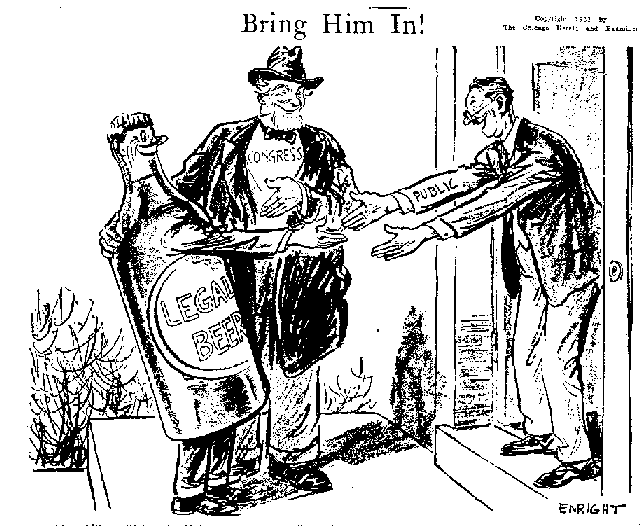
Is that overreaction, or similar previous ones, a catalyst for this new temperance movement or is it the other way around? Let’s remember that 100 years ago, the official temperance movement[4] was successful in banning alcohol nationally in the United States[5].
The Real Risk of Alcohol Consumption
Say there’s a study that finds that 2 out of 1,000 individuals drinking 0 to 1 drink daily develop cancer at a certain age. Now, let’s say that it also found that 3 out of 1,000 develop cancer with 2 drinks per day. The new temperance movement would have you believe that there’s a 50% risk increase. Why take that chance, right? Well, that depends on how you present the numbers. 50% is the relative risk. The absolute risk tells us otherwise. Only 1 more in 1000 developed cancer. That’s 0.1%.
I made those numbers up to illustrate that data can be manipulated easily. Let me put this another way. Radiation.
Hear me out. We would all agree that radiation exposure is bad, right? The more—or longer—you’re exposed to radiation, the higher the risk that you will get cancer. Surely the solution, then, is to avoid any radiation exposure. But we’re not talking “skip that trip to Chernobyl” here. To completely elude radiation, one must not get any sunlight or eat bananas. Also, don’t get x-rays. Oh, and forget about taking that flight. But wouldn’t you say that those things are also beneficial for longevity? Vitamin D is good for you. So is eating fruit and traveling. And x-rays can find health risks in time[6].
Do you see where I’m going with this? Sure, there’s a risk with drinking wine, but there are also benefits if you do it in moderation. The new temperance movement preaches abstinence, which might[7] be healthier, but if we avoid all risk, we’re setting ourselves up for a long life not worth living.
So, why is health information manipulated?
The Media’s Role
I don’t know why the U.S. Surgeon General concluded that any alcohol consumption is unsafe[8]. But I know why the press is uninterested in all the nuances I’ve been talking about today: it sells.
Here are some real headlines in The New York Times these past few months:
- A Call to Note Risks of Cancer On U.S. Alcohol.
- Dr. Oz Says Drinking Is a “Social Lubricant.” Some Experts Worry About That: “Most of the harm that comes from alcohol,” said one researcher, is “due mostly or mainly to drinking with their buddies.”
- For a Healthier Diet, Consider Your Drinks.
- Researchers Link Heavy Drinking to Worse Strokes.
- What Alcohol Does to the Body: From the moment you take a sip, drinking starts to influence your biology.
I don’t think that The New York Times is pushing the new temperance movement’s agenda. It’s just that they have an audience interested in this type of coverage. They sell papers and get clicks and interactions. The newspaper’s subscribers are either aging and looking for tips on how to live longer or younger readers looking for information on wellbeing. Health topics are popular, and that seems particularly true of the ones about alcohol consumption. Media outlets might actually prefer to publish controversial content because it drives engagement, even if the comments section becomes toxic.
Of course, it’s unfair to only highlight one side of the conversation. The New York Times also covers moderate consumption benefits, so it’s fair to say they’re not in the pockets of the new temperance movement. Look at this couple of headlines, also from the past few months:
- New Guidelines Abandon Daily Limits on Alcohol
- Is a Little Alcohol Good for Your Health? A Controversy That Reignited.
The New Temperance Movement Doesn’t Want You Healthier
I mean, they don’t want you unhealthy. They just want you to stop drinking. They don’t care about your health.
For instance, is there a close inspection of what you’re substituting your drinks with? Most mocktails are sugary, because they’re aiming to substitute the buzz you get from alcohol with something. Sugar gives you a high, so that’s what bartenders use. Wine is similar. Dealcoholizing wine is a complex process in which regular wine is made and then alcohol is removed through physics and technology.
The problem is that wine has a relatively high amount of alcohol to remove; most fall between 12% and 14% A.B.V. This leaves a void in the finished product; you can tell something is missing. Non-Alcoholic wine tends to feel unbalanced and too acidic. Furthermore, alcohol adds texture, which is hard to replace. Producers have once again turned to sugar to balance the wines.
Sugar, again. It almost feels like the sugar industry is behind this new temperance movement and the recent demonization of alcohol[9].
Sugar, however, isn’t healthy either. Is drinking sugary wine better than drinking regular wine? I honestly don’t know, but I enjoy regular wine more[10], and I probably already consume too much sugar in my daily diet.
The Last Drop
I’ve made light of a situation blaming an imaginary new temperance movement, but at no point do I want to make light of those suffering from alcohol dependency. I advocate moderate and responsible drinking, but I understand that for many that’s not an option, and that abstinence is the only viable and healthy alternative.
That said, I am a little serious about a new temperance movement acting behind the scenes. Maybe it’s hard to define what moderate drinking means? Can we really set a limit on how many drinks per day or week or year are reasonable? Perhaps this is why the easy way out is to just say that zero drinks is the answer. Or is there a darker hand at play?
Lastly, what is responsible drinking? I mean, don’t drink and drive, right? That one’s easy. What about drinking underage? Well, that one’s not that simple. I mean it is, but the legal drinking age is different from country to country. Why is that? For most of the world it’s legal to drink when you turn 18. In the United States, the age is 21. I believe wine and beer are allowed from the age of 16 in Germany. So, is it responsible for a U.S. teenager to buy wine in Germany at 16? What legal drinking age makes more sense?
What do you think? Is there a new temperance movement at play? If you’re reading this, you probably enjoy wine as much as I do, but what do you think of the risks associated with alcohol? My opinion is that life is too short for detox marketing.
Footnotes
[1] This is the report I’m talking about, if you want to read the whole thing.
[2] Yet another report for you to read.
[3] If your doctor tells you not to drink because of specific health issues that you might be going through, like heart, kidney, or liver disease, maybe don’t drink until they clear you.
[4] There were several movements acting to outlaw alcohol, but efforts in the early 1900s were coordinated by the Anti-Saloon League, which still exists today as the American Council on Addiction and Alcohol Problems.
[5] Prohibition lasted from 1920 to 1933.
[6] This whole paragraph draws information and inspiration from Dave McIntyre’s article The New Prohibition, Part 2. You should also read Part 1.
[7] I hope everything you’ve read so far in this article makes you realize that it’s at least just as likely that there are some benefits to moderate consumption.
[8] Tin-foil-hat me thinks that there really is a new temperance movement pulling strings behind the curtain.
[9] This is a reference to when the sugar industry successfully blamed fat for the health problems it was causing. Here’s an article about it.
[10] Yes, I’m aware that a lot of the wine I drink has residual sugars, but that comes naturally from the fruit, and it’s not normally added. Sparkling wine is one exception.
Cover Image: The new temperance movements wants you to stop drinking alcohol. Photo by Eva Bronzini.




Leave a Reply